
Attempt to Supply Real-World Details on Ukraine Conflict
The historical record suggests that when the US enters or sponsors armed conflict, three things typically result:
- profits for oil companies;
- media propagation of news favoring war; and
- profits for arms companies.
The current Ukraine conflict obeys these real-world tendencies, as follows.
- PETROLEUM
The Ukraine Natural-Gas Fields
US oil companies have targeted a group of “enormous” gas fields controlled largely by Ukraine Underneath the Black Sea and the Sea of Azov.
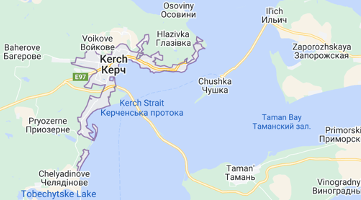
During the period that Ukraine has bought gas from Russia, US policy has been “reducing Ukraine dependence on Russian gas.” Under this banner, in April 2006, Texas-based Vanco Energy and Ukraine signed a production-sharing agreement for the Prykerchenska gas field bordering 6.5 miles off Russia’s coast (the same, that is, as if a Russian oil company positioned off California).[1]
Smallish Vanco beat out giants Exxon and Shell, and critics suggested organized crime had sneaked into the Vanco deal, writing,
“(This suggested) there had been no due diligence and the contract was not transparent.” [2]
In other words, reportedly the 2006 contract was fraudulent, a criminal undertaking.
The Odesa Oil Mafia
The reason criminals are key to any Texas-owned gas getting shipped west – from Ukraine’s only deep-water port, Odesa – is that the Odesa “Oil Mafia” controls the city, under its leader, mayor Gennady Trukhanov.[3] Trukhanov was strongly pro-Russia as of 2006, the time of Vanco’s contract.[4]
That meant persuasion was necessary for the criminals whose turf was the crucial port.
Who could both represent US oil interests and make rapprochement with pro-Russia gangsters? Well, CIA agents, because a job for the agency was the State Department goal of “reduced Ukraine dependence on Russian natural gas,” i.e., Ukraine’s burning of its own gas as developed by US companies.
Likely toward this goal, the CIA had recruited Valentyn Nalyvaychenko, Ukrainian ambassador to the US from 2001 to 2003, [5] who in 2006 would take over as the country’s top spy[6] while Vanco signed its contract with Ukraine. This allowed CIA agents free rein and time in Trukhanov-controlled Odesa, key to shipment of Vanco natural gas.
Trukhanov could be pressured, because he hid ill-gotten gains in an offshore shell-company network that the CIA was extremely familiar with.
The Offshore Network
Reports entitled the Panama, Paradise, and Pandora Papers revealed routine use of networked offshore shell companies by the world’s powerful, including Ukraine’s Trukhanov. One reason the CIA was so familiar with this network is that the CIA is one of the biggest hiders of money in the network, according to The Papers.[7]
The record shows the CIA routinely had access to the law offices, including Mossack Fonseca, that registered shell companies in tax-haven nations. In CIA parlance, these firms were assets for the agency.[8]
CIA access to Mossack Fonseca
The Papers note that Mossack Fonseca, a Panamanian law firm, created a remarkable number of offshore shell companies to hide ownership of money both licit and illicit for people so powerful they could influence world affairs. Some news reports refer obliquely to a CIA connection for Mossack Fonseca.
As the Raleigh News Observer put it,[9]
“Mossack Fonseca (builds) labyrinthine corporate structures that sometimes blur the line between legitimate business and the cloak-and-dagger world of international espionage.”
The espionage aspect is no surprise: Company founder Jurgen Mossack is the son of a former Nazi who came to work for the CIA. Jurgen’s father Erhard was a member of the Waffen SS serving Germany’s Third Reich. Like many other former Nazi officers, Erhard Mossack sought to ingratiate himself with the US by moving to Latin America and espousing anti-communism. The Mossack family with young Jurgen moved to Panama in the 1960s where,” the New York Times wrote (based on a CIA document dated October 3, 1963 [10]),
“Mr. Mossack’s father offered to spy for the C.I.A.”
The Times misleadingly understates, because the October 1963 CIA document i several times mentions a CIA plan for “terminating” Erhard Mossack – thus denoting clearly that Mossack did in fact work for the CIA.[11]
Erhard’s son Jurgen founded Mossack Fonseca in 1977.[12] Certainly no more than two years after 1977, Mossack Fonseca and the CIA had contracted to form shell companies to conceal financial dealings, such as financing of the illegal Contra army against Nicaragua.[13] Similarly, an unknown number of the CIA’s important informants used Mossack Fonseca. [14]
CIA access to Baker McKenzie
Registering shell companies offshore for Ihor Kolomoisky was Chicago’s Baker McKenzie,.[15] The New Republic reported,[16]
“Baker McKenzie is an architect and pillar of a shadow economy…that benefits the wealthy….”
Baker McKenzie’s Moscow office employed CIA asset Thomas Firestone.[17]
With this “offshore-network” dirt, the CIA had enough purchase on Ukraine gangsters in control of Ukraine Black Sea oil shipments that in 2012 Exxon and Chevron could win large Black Sea gas licenses from Ukraine. However, the future of these licenses wasn’t secure, because the licenses went against the interests of Russia, and then-president of Ukraine Victor Yanukovych favored future alignment with Russia, not the West. Yanukovych spurned the idea of NATO for Ukraine.
Perceived need for “regime change”
This Yanukovych rejection of westernization for Ukraine had to have irked the most powerful Americans – both oil executives and the State Department officials charged with securing the interests abroad of large US corporations. Fortunately for the US, Yanukovych irked many western Ukrainians, too. The State Department commenced mobilizing these dissidents, against Yanukovych – making “regime change” the thought of the day.
Such thought needed media to propagate it.
- PROPAGANDA
An American “Tech Camp” in Kyiv
In 2012, the US government hosted an event inside its Kiev embassy, announcing,
“From September 12 to 13, 2012, the Department of State will host ‘TechCamp Kyiv’ supporting Secretary of State Hillary Clinton’s Civil Society 2.0.
Officials said,
“More than 80 civil society leaders from throughout the Ukraine and surrounding countries come together to get hands-on training in…online organizing….” [18]
“Online organizing” here meant organizing through social media, such as Facebook, and State Department officials paired visiting Facebook techs with reps from Ukrainian “civil society organizations,”[19] who preferably were opponents of Yanukovych.[20]
As such, prominent Yanukovych opponent Mustafa Nayem almost certainly attended. Nayem is a well-known “liberal Ukrainian TV journalist.” When the Tech Camp Kyiv event finished, Nayem went onto Facebook – to organize. Within two months, Nayem was leading a radical anti-Yanukovych group, via Facebook posts, while demonstrations began in Kiev’s Maidan Square.
As Business Insider reports,
“On November 21, 2013, Mustafa Nayem, a thirty-two-year-old liberal television journalist, posted an angry message on Facebook. This Facebook post started the Ukrainian revolution.”
This Facebook post reads as follows:
“Well, let’s get serious,” wrote Nayem. “Who today is ready to come to Maidan before midnight? ‘Likes’ don’t count. Only comments under this post with the words, ‘I am ready.’ As soon as we get more than a thousand (posts of ‘I am ready’), we will organize ourselves.”[21]
It worked. Yanukovych was ousted.
Notably, in months following the US tech camp, Nayem’s employer Hromadske TV received nearly $120,000 from a combination of NATO-country embassies and various “private donors.”[22]
Notably too, already the US three decades previously was cultivating anti-Russia journalists in Ukraine – even before the 1991 end of the Soviet Republic of Ukraine. Ukrainian Olga Baysha writes,
“(I) graduated from Kharkov University, and one day in 1990, I was invited to work as a journalist, by a university friend. Next day, without prior experience, I started reporting.
Baysha continues,
“New uncontrolled media, the number of which was increasing at a huge rate daily, demanded more and more media workers. In the overwhelming majority of cases, they were young ambitious people without any journalistic education or life experience.
She continues,
“What united us was the desire to Westernize (along with) a lack of understanding of societal contradictions characterizing the post-Soviet transition, and deafness to the concerns of working people who opposed ‘reforms.’”[23]
Now, US leaders once again have recruited social-media pundits. In March 2022, one month after outbreak of the Ukraine war, White House staff convened the nation’s top Tik Tok and Twitter pundits, around 30 of them, and gave them material to broadcast on Ukraine.
Present was Marcus DiPaola, with 3.5 million TikTok followers, who described that,
“(The White House wants ‘creators’ to broadcast that) Russian troops are not happy with their own invasion, it’s really impacting Russia’s ability to make progress, (and) Russia is not going to win (because) things have gone so badly for them.”
This appears to be what the White House wants American parents to explain to their children about Ukraine.
As of 2014, president Yanukovych was out as desired, but for the man who would succeed him, a lot more message propagation was needed – to create an image large enough to overshadow facts.
That is, Volodymyr Zelensky had baggage.
Zelensky and the Offshore Money Network
In 2012, before Maidan, more than $1 billion traveled offshore to Zelensky’s[24] SVT Films Ltd. Belize office from Kolomoisky’s 1+1 Group British Virgin Islands office, [25] a shell likely created by Baker McKenzie.
Laundered Kolomoisky money benefited Zelensky in two ways.
It created the Azov Battalion,[26] which fought to aid Ukraine Westernization – by attacking and disrupting pro-Russia separatists in eastern Ukraine who were fighting to reverse the coup against Yanukovych.
Laundered Kolomoisky money also funded a TV show creating a name recognition for Zelensky without which Zelensky could not have run for president.
When Zelensky was elected in 2019, showing results for an American long game of regime change fueled by propaganda, the US was positioned to increase profits for its arms companies – whenever fighting expanded in Ukraine. Fighting expanded on February 6, 2022.
- ARMS SALES
US Arms to Ukraine
Of all armaments sold worldwide, US companies sell approximately one half.[27] This illustrates that the US economy depends utterly on arms sales when, as now, petroleum development is not maximally profitable. In 2016, nearly six years before Russian troops entered Ukraine, Ihor Kolomoisky received a US arms shipment – or rather did his hired militiamen, the Azov Battalion. It was rocket launchers, from Texas-based AirTronic, earning that company $5.5 million.[28]
AirTronic was permitted to arm these private fighters because Ukraine at the time had only a small government army and no weaponry to arm it [29] (this was true because in 1991, as the USSR dissolved, with assistance from dishonest army generals, gangsters [including the above-named Gennady Trukhanov] stole and black-marketed Ukraine’s Soviet-supplied weaponry[30]).
About $2.4 billion in US contracts are signed[31] with Lockheed and Raytheon for arms including Javelin, Stinger, and HIMARS missile systems – to replenish weapons sent to Ukraine from US arsenals.
In May 2022, Biden spoke to workers at an Alabama Lockheed plant. From a podium flanked by missile launchers, Biden said,
“The United States is leading our Allies and partners around the world to make sure that courageous Ukrainians who are fighting for the future of their nation have the weapons and ammunition to defend themselves….You’re doing it. ….You’re making it possible for the Ukrainian people to defend themselves without us having to risk getting in a third world war by sending in American soldiers fighting Russian soldiers….
“In order to do that, we have to make sure our vital defense suppliers] are getting the inputs…they need to produce…the full capacity.
“And I’m once more urging Congress to quickly pass the supplemental funding bill for over $30 billion to help the Ukrainians so they can keep all of you very, very busy for a while here.”[32]
[1] Registered in Bermuda, Vanco partnered with Nathaniel Rothschild, whose famous family are members of Bilderberg Group of the world’s hyper wealthy. Rigzone Web site, April 21, 2006
[2] Taras Kuzio, “Ukraine: Democratization, Corruption and the New Russian Imperialism,” Political Science, 2015. Also cf. Jamestown Foundation, US, in its publication Eurasia Daily Monitor, September 16, 2008. Note in this regard that in November 2012, Ukrainian oligarch Rinat Akhmetov bought a controlling share in a company called Vanco Ukraine, registered in the British Virgin Islands. Ukrinform Web site, January 30, 2013 The record shows that a company called Vanco Prykerchenska was part-owned by Rinat Akhmetov, Ukraine oligarch and gangster. Prykerchenska is the name of the gas field for which Vanco Energy secured its deal. According to political journal’s Post-Soviet Affairs, and The Nation, Akhmetov was investigated on murder charges and for his alleged role in organized crime in the Donetsk region.
[3] A loose ally of Trukhanov’s, oligarch Ihor Kolomoisky,[3] controls the Odesa port facility itself
[4] According to a 1998 Italian police report, “Mafia Ucraina,” on Ukraine’s “Neftemafia” (“oil mafia”).
[5] Wikipedia
[6] Soon, Vice President Joe Biden was calling Nalyvaychenko “my man in Kyiv.”
[7] To say the CIA “controlled” this network might be too strong, but “monitored” would be too weak. “Abetted” is probably fair, and so is “benefited from.”
[8] Of course, by extension the entire offshore network itself is one large CIA asset as the agency does its job of keeping tabs internationally on big-money illicit activities including arms-for-drugs deals.
[9] On April 7, 2016.
[10] The Internet version of the New York Times story of April 6, 2016, contains a hyperlink to the original CIA document. The link is marked as follows: Original Document (PDF) »
[11] The document offered reasons for Erhard Mossack’s proposed termination; namely, potential “embarrassment” and potential poor “security” if the CIA kept Mossack employed.
[12] It is likely that as previous employer of Jurgen’s father, the CIA soon became a client of the Mossack Fonseca law firm.
[13] April 12, 2016, in Munich’s Suddeutsche Zeitung, the original newspaper recipient of the Panama Papers files.
[14] Yahoo News, April 12, 2016, quoting Germany’s Suddeutsche Zeitung of April 3, 2016.
[15] Business Insider, October 4, 2021
[16] October 18, 2021, Citing research by the International Consortium of Investigative Journalists, Inc.
[16] Law.Com Web site May 23, 2013 “Amid Alleged CIA Spy Scandal, Russia Boots Baker & McKenzie Lawyer” Russia says Thomas Firestone was recruiting a Russian agent for the CIA.
[18] State Department release September 11, 2012
[19] US State Department document
UNCLASSIFIED U.S. Department of State Case No. F-2014-20439 Doc No. C05792554 Date: 11/30/2015
[20] Eric Zuesse, Modern Diplomacy Web site, June 4, 2018
[21] Business Insider September 5, 2015 This excerpt comes from Andrei Soldatov and Irina Borogan’s “The Red Web.”
[22] Hromadske Financial Report. Nayem’s father and Nayem himself lived in Afghanistan and in Russia before Nayem moved to Ukraine. This is the kind of family that the CIA keeps tabs on and frequently approaches members of to become agency assets
[23] Consortium News Web site, April 29, 2022 reprinted from Grayzone
[24] Fifty percent-owned
[25] The Pandora Papers
[26] Business Insider, March 25, 2015
[27] Russian companies sell less than one-twentieth of all arms. Stockholm International Peace Research Institute (SIPRI) Arms Industry Database
[28] It was likely via Odesa with its mob-controlled harbor and military installations that the Azov Battalion received among the earliest US arms shipments[28] toward countering separatists in eastern Ukraine. As such, recently when Russia attacked a reported “airfield near Odesa” on April 30, 2022, it almost certainly was either the Trukhanov-controlled Zastava or the Trukhanov-controlled Shkilny. Russia on Sunday said it had struck at weapons supplied to Ukraine by the United States and European countries and destroyed a runway at a military airfield near the Ukrainian city of Odesa, news agency Reuters reported.
[29] The Ukrainian army was so pitiful when fighting broke out the Donbas in April 2014 that President Petro Poroshenko had to outsource the nation’s defense to volunteers.” Alexander Clapp, “The Maidan Irregulars, “What Clapp leaves out is why. It was because post-Soviet Ukraine officials sold off weapons and stole the military budget.
[30] It is estimated that between 1992 and 1998, some $32 billion in military material disappeared from military depots in Ukraine
[31] “Department of Defense Moves Quick to Replenish Weapons Sent to Ukraine,” DOD, September 9, 2022
[32] Ukraine’s US-supplied HIMARS (High Mobility Artillery Rocket System), costs (with some ammo) $5.6 million per unit. Wikipedia